Sho Madjozi

Asserting Culture into Artistry

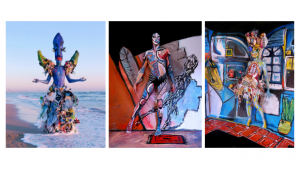
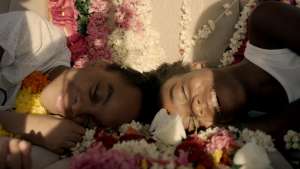
At the Design Indaba’s 25th anniversary, South African musician, poet and cultural icon Sho Madjozi opened the conference with her undeniable creative energy and unapologetically African perspective. Delivering a part performance-part design talk,  Sho Madjozi shared how identity, heritage and popular culture can become powerful tools for creative expression and cultural representation. Known for blending her Tsonga traditions with contemporary music, fashion and storytelling, Madjozi's presentation explored how embracing local identity can create work that resonates globally without compromising authenticity.

Reflecting on her journey from academic and poet to internationally recognised performer, Sho Madjozi challenged the assumption that success requires conformity to Western cultural norms. Madjozi shared how her breakthrough emerged from leaning more deeply into her Tsonga heritage, incorporating indigenous languages, traditional aesthetics and distinctly South African references into her music, identity and performances..

Throughout the talk, Madjozi emphasised the importance of cultural confidence, reflecting on how many African creatives have been encouraged to look outward to the West for validation and inspiration while often overlooking the richness of their own communities and traditions. Madjozi asserted that creativity flourishes when artists draw from their lived experiences and cultural roots, turning personal narratives into universal stories.

A joyful and empowering celebration of African identity and Tsonga culture, Sho Madjozi’s talk reminded audiences that culture is not static heritage to be preserved but a living force that can shape the future.


Watch the full Design Indaba talk here.


Plastic Tapestries

Moffat Takadiwa transforms Zimbabwe’s plastic waste into powerful tapestries
Posted 12 Jun 26 By Design Indaba Craft Creative Work / Design News Comments

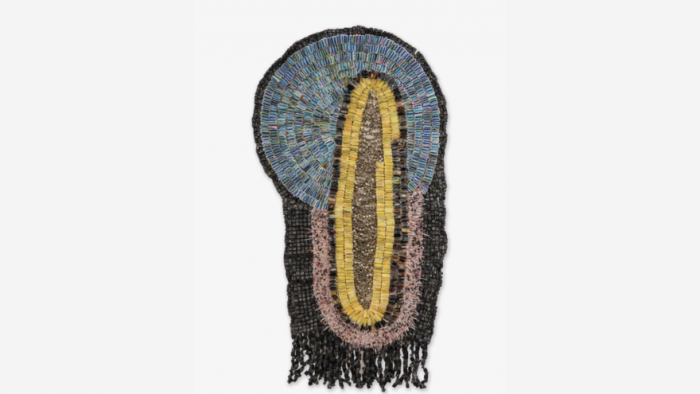
Zimbabwean artist Moffat Takadiwa is turning discarded plastic into artistic tapestries designed to become a record of extraction. Takadiwa gathers plastic consumer waste from recycling centres and dumping sites across Harare, meticulously sorted by colours and textures and then arranged and drilled into a woven-like artwork that blur the boundaries between tapestry and sculpture.

At first glance, the undulating surfaces resemble richly textured textiles and at a closer look reveals thousands of individual plastic components, each carrying traces of global trade, consumption and disposal. The artist’s practice is deeply rooted in Zimbabwe’s social and economic realities. Based in Mbare, one of Harare’s largest recycling hubs, Takadiwa works with materials that reflect the flow of imported goods and the environmental consequences they leave behind. His compositions draw attention to the enduring effects of colonial extraction and unequal global trade systems, revealing how the residues of consumer culture continue to shape African landscapes.

Many of the works incorporate computer keyboard keys, a recurring material in Takadiwa’s practice. Arranged into dense topographies and flowing patterns, the keys become fragmented alphabets that explore themes of language, identity and cultural memory. Other works feature beauty products, toothbrushes and household objects, connecting personal rituals to broader questions of consumption and value. Despite their critique of environmental degradation and economic imbalance, the works are ultimately acts of repair. The painstaking process of collecting, sorting and weaving transforms discarded objects into forms of extraordinary beauty. Craft becomes a tool for slowing down systems built on extraction and disposability. Takadiwa, through his art offers an alternative narrative to waste, one in which discarded materials are not the end of a story, but the beginning of a new one.

Conflict Ecology

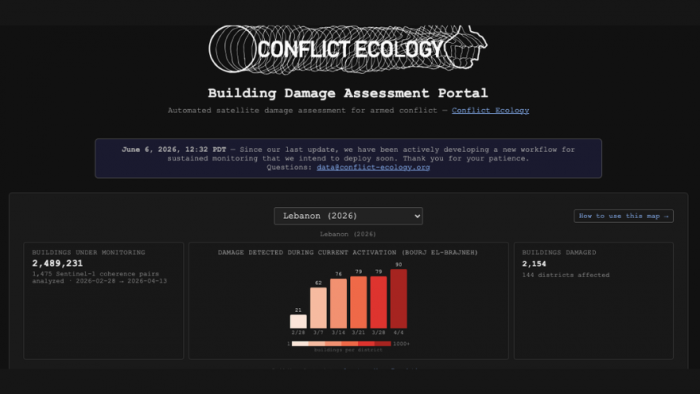
The Geospatial research studio who is using radar technology to reveal the hidden impact of conflict.

The geospatial research studio Conflict Ecology, has developed a method of using synthetic aperture radar (SAR) satellite data to identify and map damage to buildings across conflict areas such as Lebanon, creating a detailed picture of the resulting impact that might otherwise remain unseen. visual record. Unlike conventional satellite imagery, which depends on weather conditions, daylight and clear visibility, radar actively sends signals towards the Earth and measures how those signals return. By comparing changes in reflected waves over time, researchers can detect structural damage that may not yet be visible in photographic imagery.

The project highlights the growing role of design within fields traditionally associated with science and conflict analysis. Through mapping, visualisation and interface design, complex datasets become tools for public understanding. The resulting maps transform abstract statistics into spatial narratives, revealing how neighbourhoods, towns and communities are reshaped by violence. Using data gathered by the European Space Agency’s Sentinel-1 satellite constellation, Conflict Ecology analysed more than 2.4 million buildings across Lebanon, within just five weeks of renewed conflict, the team identified damage to over 2,000 structures, translating vast amounts of satellite information into an accessible and interactive visual record.

Conflict Ecology's work forms part of a broader movement that combines satellite technology, open-source intelligence and data design to document events in near real time, demonstrating how remote sensing technologies are becoming critical instruments of accountability. While maps cannot capture the human cost of war, they can provide an independent record of what has happened on the ground. In doing so, they demonstrate how design can function as a tool for documentation, transparency and justice.

Led by Donkeys

Satire, activism and creative resistance

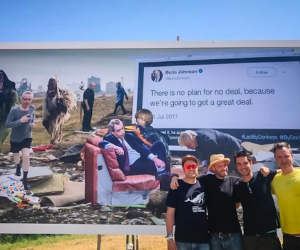
At Design Indaba’s 25th Edition, British political art collective Led By Donkeys delivered a captivating and entertaining talk to demonstrate how design can become a powerful tool for activism. Formed during the height of the Brexit crisis in the United Kingdom, the anonymous group began as a guerrilla poster campaign exposing contradictions, broken promises and public statements made by pro-Brexit politicians. What started as a late-night act of protest quickly evolved an influential political communication movement.

During their presentation, Led By Donkeys reflected on how frustration with political misinformation and media failure motivated them to take matters into their own hands. Using little more than ladders, wheatpaste and billboard space, they transformed politicians’ own words into public interventions. They reproduced archived quotes and social media posts in highly visible urban spaces, to draw attention to what they describe as political hypocrisy while inviting citizens to engage more critically with political discourse.

The collective explored the role of humour and satire in political engagement, with many of their projects being deliberately provocative, their work relies on wit, using irony and visual simplicity to reach broad audiences across ideological divides. Campaigns such as purchasing the domain name thebrexitparty.com and offering to sell it back to Nigel Farage became examples of how creative interventions can generate public debate while exposing contradictions within political narratives.

Led By Donkeys presentation showcased how graphic design can move beyond branding and commerce into the realm of democratic participation. Their presentation highlighted the power of creative activism to challenge authority, provoke conversation and re-engage citizens in political life. Through satire, public intervention and strategic communication, they showed that design can be both a cultural weapon and a tool for collective accountability.


Watch the full Design Indaba talk here.

Joy through resistance

Yinka Ilori’s latest exhibition showcases his deeper roots of joy

Yinka Ilori’s, British designer of Nigerian heritage, known for his bold colour and playful interventions that bring delight to public spaces, has opened his latest exhibition ‘Joy through Resistance: He Who Laughs Last, Laughs Best’. The exhibition is his most personal body of work to date, shifting the conversation away from joy as an aesthetic and towards joy as a form of survival. For Ilori, joy is not an escape from hardship, instead, it emerges through it. The exhibition’s title, borrowed from a proverb familiar across many cultures, speaks to perseverance rather than celebration alone, the “last laugh” belongs to those who endure.

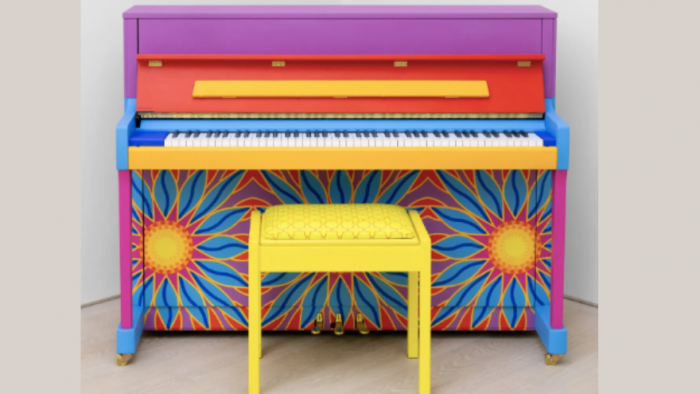
Showcasing at London’s Cristea Roberts Gallery, the exhibition marks Ilori’s first solo gallery presentation in his home city. The exhibition features paintings, prints, sculpture and an immersive sound installation. Visually, floral motifs pair the Nigerian yellow trumpet flower with the British daffodil, creating a visual dialogue between Ilori’s Nigerian heritage and his London upbringing. The recurring use of lace references both memory of home life and the ceremonial traditions of West African communities, where fabric becomes a symbol of dignity, pride and self-expression.

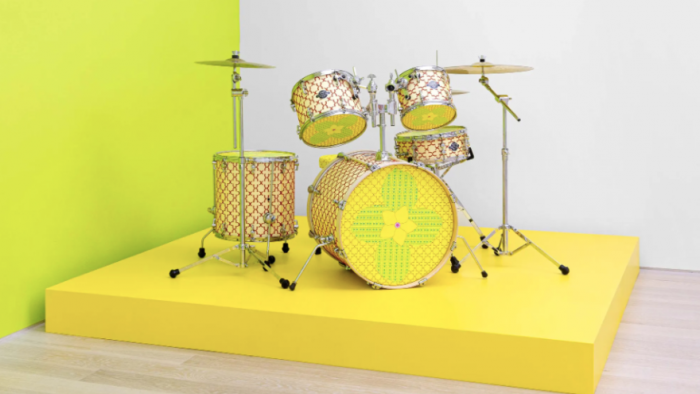
Music and sound play an equally important role. Handmade congas and lace-wrapped percussion instruments form part of an immersive installation developed with composers Peter Adjaye and James William Blades. Through layered recordings, hymns and rhythms, the gallery becomes a space where memory is experienced as much through sound as through visuals.

The exhibition also echoes themes explored in the accompanying film Joy Through Resistance: He Who Laughs Last, Laughs Best, which positions joy as a collective practice rooted in community, culture and shared experience. Rather than presenting optimism as naïve or passive, Ilori frames it as an active response to uncertainty and displacement – promoting joy as a form of resistance.

Sound and Light Soother

Motorola’s S1 Soother Brings Emotional Design to the Nursery

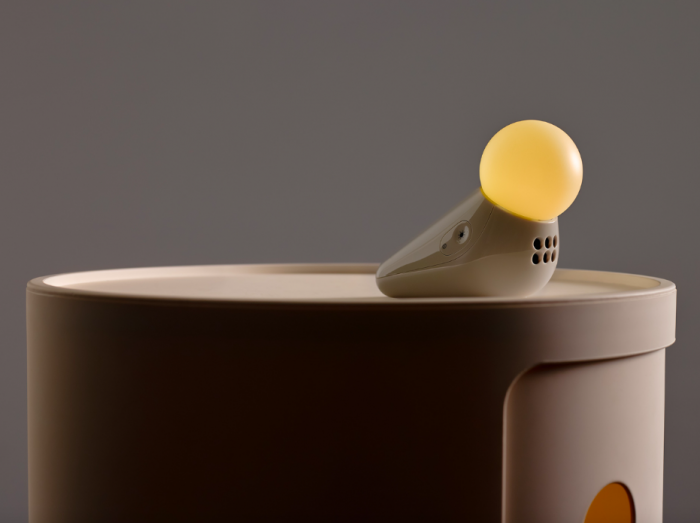
British industrial designer Tej Chauhan for Motorola Nursery has designed a soothing device that acknowledges the emotional experience of caregiving. The S1soother is designed to move effortlessly between utility and companionship. Inspired by the soft, approachable form of a seal, the compact device combines a dimmable night light with soothing sounds and lullabies to help calm infants during bedtime, creating a reassuring presence within the home.

Created as part of Motorola Nursery's design-led PIP collection, the S1 reflects Chauhan's long-standing belief that technology should feel approachable and emotionally engaging. Challenging convention, Chauhan’s design avoids presenting itself as another piece of childcare equipment and uses soft curves, playful proportions and a friendly silhouette to establish an immediate emotional connection. The soother features seven mood-light colours, ten soothing sounds and a rechargeable portable form. What distinguishes the design is its emphasis on emotional utility. The calming form serves as a reassuring companion during moments when parents cannot be physically present. By giving the product a recognisable personality. Chauhan’s thoughtful design shifts the focus from pure functionality to the broader experience of comfort and connection. The result is a product that creates a reassuring presence within the home.

A Bracelet That Translates Sign Language

Nura’s bracelet design wins the 2026 Rimowa Design Prize

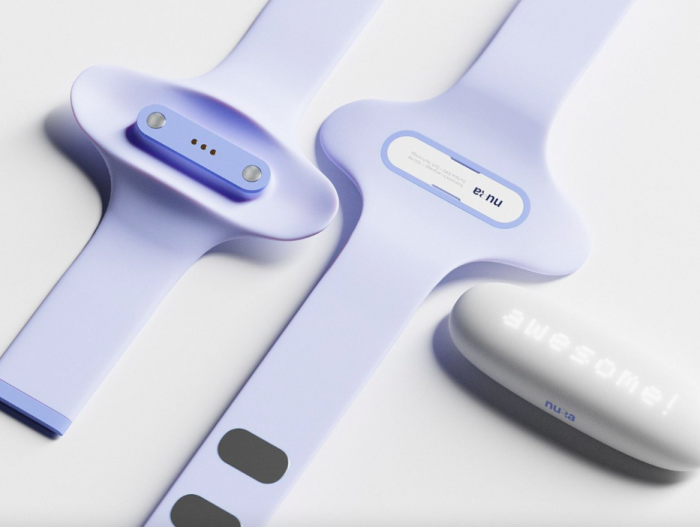
The winner of the 2026 Rimowa Design is a wearable device that aims to solve for the communication barrier between hearing impaired and hearing communities. The Nura bracelet, designed by German students Samuel Nagel and Paul Feiler, translates sign language into spoken language while simultaneously converting speech into text. The device uses electromyography (EMG) sensors to detect the electrical muscle signals in the forearm generated during signing to enable real-time translation between the different modes of communication.

NURA form was inspired by the graceful shape of a manta ray and conceived as an elegant accessory that users would choose to wear. The designers sought to challenge the stigma often associated with assistive technologies, demonstrating that accessibility and desirability can coexist.

The project was awarded first prize in the fourth annual Rimowa Design Prize, which challenged students from leading German design schools to rethink the theme of mobility. In a bold stance, Nura expanded the definition of mobility to include the freedom to communicate, participate and connect. While still in development, the designers hope to expand the system beyond its current vocabulary and adapt it to a wider range of regional sign languages.

NURA’s inclusive design serves as functional and aesthetic bridge between the hearing impaired and hearing communities.

Image credit: LVMH, Samuel Nagel, Paul Feiler

Ratchu Vaan Surajaras

Designing Flood Resistant Cities

Global Graduate, Thai landscape architect and urban designer Ratchu Vaan Surajaras brought presented his award winning design for climate adaptation in one of the world’s most flood-prone megacities, Bangkok. As part of the Design Indaba’s Global Graduates programme, Surajaras explored how landscape architecture can become a form of environmental infrastructure, helping cities respond more intelligently and compassionately to rising sea levels and climate change.

Focusing particularly on Bangkok’s increasingly precarious relationship with water, Surajaras explained how Bangkok’s historic canal systems and wetlands once functioned as natural flood management networks before decades of urban expansion disrupted these ecological systems. Today, the city faces severe seasonal flooding, Surajara’s project ‘Recharging Bangkok’ proposes adaptive urban systems that work with natural hydrological cycles resulting in public infrastructure that integrates flood management, ecological restoration and community use. The concept envisions parks, waterways and public spaces capable of absorbing, storing and redirecting water during periods of heavy rainfall while remaining active social spaces throughout the year. Through diagrams, speculative models and urban research, Surajara demonstrated how cities can transform environmental vulnerability into opportunities for resilience and collective wellbeing.

Watch the full Design Indaba talk here.
Jakob Trollbäck

Beauty and Logic of design

At Design Indaba’s 25th anniversary, Swedish graphic designer and branding strategist Jakob Trollbäck delivered a message about the role of design in shaping a connected world. Founder of the New York-based studio Trollbäck+Company and sustainability agency The New Division, Trollbäck explored how branding, storytelling and visual systems can influence global behaviour and collective action. Trollbäck advocates for communication to be used as a force capable of mobilising positive cultural and societal change. Best known as the architect behind the visual identity and communication language for the United Nations Sustainable Development Goals (SDGs), Trollbäck reflected on the challenge of translating complex global ambitions into a simple, universally recognisable design system. The colourful SDG wheel and iconography have since become one of the world’s most widely adopted visual frameworks for sustainability, used by governments, NGOs, corporations and educational institutions across the globe. Trollbäck emphasised the importance of clarity, emotion and accessibility in communication design. Drawing from decades of experience, Trollbäck explained that successful design must balance “beauty and logic”, a philosophy that underpins both his practice. Reflecting on the growing responsibility designers hold in an era defined by climate crisis, misinformation and social fragmentation, Trollbäck suggested that sustainability has a “storytelling problem”, where data and urgency alone are often insufficient to inspire behavioural change. Change must be made attractive, aspirational and culturally engaging if it is to gain widespread public support. Blending strategic insight with optimism, Jakob Trollbäck’s talk shared a compelling vision of design as a language capable of connecting humanity around shared goals and futures.

Watch the full Design Indaba talk here.
Enni-Kukka Tuomala

Radical Empathy

For Design Indaba’s 25th Edition, Finnish empathy designer and Global Graduate Enni-Kukka Tuomala challenged the audience to rethink empathy beyond a passive feeling, but as an active design outcome. Based in London and trained in Global Innovation Design at the Royal College of Art and Imperial College London, Tuomala uses design as a tool for breaking down social barriers, fostering dialogue and addressing what she describes as the world’s growing “empathy deficit”.

Tuomala’s talk is cantered around the idea of “radical empathy”,  a concept that frames empathy as a collective social practice capable of transforming politics, communities and institutions. Tuomala argued that contemporary societies are increasingly fragmented by polarisation, fear and exclusion, describing the modern world not as a “melting pot” of cultures but as “a mosaic of segmented communities”. In response to this, Tuomala called on designers to become “catalysts for empathy”, using creative practice to rebuild trust, understanding and human connection.

During her talk, Tuomala shared examples of her participatory empathy projects developed across London, Helsinki, Tokyo and New York. One of the most significant involved her ongoing collaboration with the Finnish Parliament, where she worked with six members of parliament from five different political parties to develop “empathy tools” for political dialogue and decision-making. The initiative sought to redesign interactions within systems of power, encouraging more humane, equal and constructive forms of communication between political opponents.

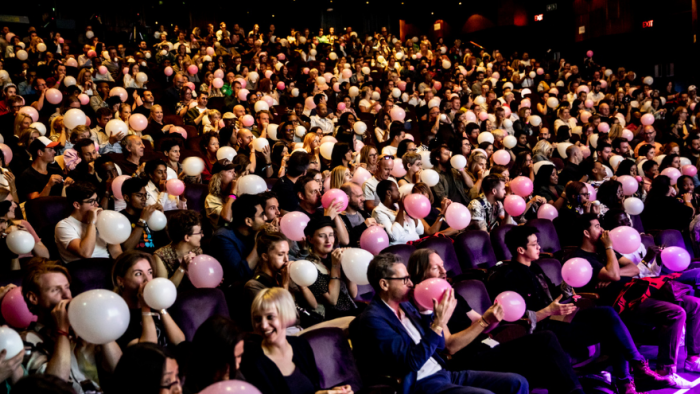
A memorable interactive moment in her talk, Tuomala invited the Design Indaba audience to participate in a simple empathy-building exercise using pink balloons placed on each seat. The interactive gesture transformed the auditorium into a temporary space of collective play and connection, illustrating her belief that empathy must be experienced physically and socially rather than discussed only in abstract terms. Tuomala’s talk showcased the catalytic power of radical empathy.


Watch the full Design Indaba talk here.


Subscribe to Design Indaba RSS